

The Vanity Confession
When people say they want to lose weight for their health, they're not telling the full story.
Not on purpose. They just say what they think they should say. Health sounds noble. Responsible. Mature. It's the socially acceptable answer that earns nods of approval at dinner parties and doctor's appointments.
But after working with over 150 founders and executives, I've learned to ask a different question. I ask them to upload a photo of what success looks like.
They all upload the same thing. Abs.
Not family photos. Not images of running with their kids. Just abs.
That's the real driver. And research confirms what my discovery forms have shown me for years.
What the Research Actually Shows
A study published in the journal Obesity examined motivations for weight loss between young adults and older adults in the National Weight Control Registry. The findings were clear: young adults were more likely to cite appearance and social motivations for weight loss, were less motivated by health, and were less likely to report a medical trigger for their decision to lose weight.
Researchers noted that health concerns do not appear to be as strong a motivation for weight loss among younger populations. Instead, the data indicate that motivation for weight loss may be driven more by appearance and social factors.
Another study published in Psychology of Sport and Exercise found that people project more virtuous health motives to others despite being actually driven by physical appearance motives. The researchers described this as meeting the standards to both appear slim and appear to have good values by disguising true motives.
In other words, people lie about why they want to lose weight. Not maliciously. They say what sounds acceptable while privately motivated by how they look.
Why Vanity Is Not a Dirty Word
The fitness industry has created a strange paradox. We celebrate physical transformation but shame the motivation behind it. We post before and after photos while claiming we did it for longevity.
Here's the uncomfortable reality: vanity works as a motivator.
When someone uploads a photo of abs as their definition of success, they're being radically honest with themselves. They're acknowledging that their motivation is tied to self worth, posture, pride, and confidence. Not the external fake confidence they've mastered over decades in boardrooms. The authentic kind where you look in the mirror and just smile.
A systematic review in Appetite examined 36 studies on psychological benefits of weight loss and found consistent improvements in self esteem, body image, and health related quality of life following weight loss interventions. The psychological benefits occurred regardless of whether weight loss was the primary outcome.
The person who wants to see their abs in the mirror is not shallow. They're pursuing something that will measurably improve their psychological wellbeing.
The Transformation Nobody Talks About
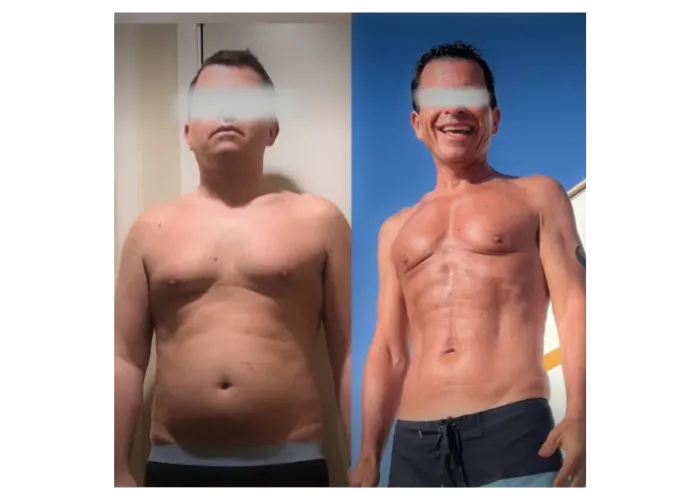
I lost 25 kilos at 55. The transformation made me unrecognizable. To the point where you look back at photos and wonder who the hell that was.
But the biggest change wasn't the abs.
It was that killer smile in the after photo. Unapologetically proud.
Research from a 2025 study presented at the American Society for Metabolic and Bariatric Surgery found that self esteem scores increased 131% within one year of significant weight loss. The researchers tracked nearly 5,800 patients and found a direct link between weight loss and rising confidence, with the greatest psychological boosts seen in those who lost the most weight.
The study authors noted that weight stigma is associated with adverse health outcomes including depression, anxiety, and low self esteem. Addressing weight through physical transformation doesn't just reshape bodies. It reshapes minds.
Why Information Alone Does Not Produce Results
There is unlimited information available on how to lose weight. You can Google calories, macros, and workouts. The science of fat loss is not hidden.
But coaching is more than information delivery. It's everything else that sabotages your efforts every time.
It's the uncertainty. The failed attempts. The unsolicited advice from those who care most about you. The voice in your head that says you've tried before and failed. The social pressure to eat and drink in certain contexts. The identity conflict between who you are and who you're trying to become.
A study in Health Psychology Review examined the role of self worth in weight loss treatments and found that a sense of self worth cannot be meaningfully altered with information or cognitive strategies alone. The researchers noted that when people perceive themselves as inadequate, they live accordingly. A negative self perception robs many overweight patients of the faith in themselves to do what it takes to be healthy.
This is why transformation requires more than a meal plan. It requires addressing the psychological barriers that information alone cannot touch.
Conclusion
Stop apologizing for wanting to look good.
The person who uploads a photo of abs as their success metric is not vain. They're honest. They understand that physical transformation produces psychological transformation. They know that the smile in the after photo represents something far deeper than aesthetics.
Health will come as a byproduct. The blood markers will improve. The energy will increase. The risk factors will decrease.
But the reason you'll sustain it? That's the smile. The posture. The confidence. The version of yourself you've been waiting to meet.
Want your smile back? And your abs?
Scientific References
LaRose JG et al. Differences in motivations and weight loss behaviors in young adults and older adults in the National Weight Control Registry. Obesity. 2013;21(3):449-453. https://pmc.ncbi.nlm.nih.gov/articles/PMC3630273/
Vartanian LR, Wharton CM, Green EB. Appearance vs. health motives for exercise and for weight loss. Psychology of Sport and Exercise. 2012;13(3):251-256. https://www.sciencedirect.com/science/article/abs/pii/S1469029211001750
Lasikiewicz N et al. Psychological benefits of weight loss following behavioural and/or dietary weight loss interventions. A systematic research review. Appetite. 2014;72:123-137. https://www.sciencedirect.com/science/article/pii/S0195666313003991
American Society for Metabolic and Bariatric Surgery. Self esteem skyrockets 131% after weight loss surgery, study reveals. ASMBS 2025 Annual Scientific Meeting. https://www.sciencedaily.com/releases/2025/06/250620030326.htm
Cochrane G. Role for a sense of self worth in weight loss treatments: Helping patients develop self efficacy. Canadian Family Physician. 2008;54(4):543-547. https://pmc.ncbi.nlm.nih.gov/articles/PMC2294089/









Mail
Facebook
LinkedIn
X
Pinterest
Snapchat
Reddit