
Budget Your Calories

Budget Your Calories

March 09, 20267 min read

Budget Your Calories: Why Fat Loss Works Exactly Like Paying Off Debt

If you are behind on payments, you do not keep spending like nothing happened. You tighten your budget. You cut luxuries. You prioritize necessities until the books balance.

Fat loss operates on the same principle. Your body runs a ledger. Calories in versus calories out. When you spend more than you earn, the surplus gets stored as fat. When you consistently spend less than you earn, the deficit forces your body to pull from its reserves. That reserve is body fat.

This is not an opinion. A randomized controlled trial published in Annals of Nutrition and Metabolism by Strasser et al. (2007) demonstrated that fat loss depends on energy deficit alone, independent of the method used to create it. Whether you diet, exercise, or combine both, the deficit is what drives the result.

Yet 40.3% of American adults are obese, according to the most recent CDC data from the National Health and Nutrition Examination Survey (Emmerich et al., NCHS Data Brief No. 508, 2024). The issue is not that people lack information. The issue is that they never learned to budget.

Your Body Runs on a Balance Sheet

Think of your Total Daily Energy Expenditure (TDEE) as your income. It is the number of calories your body burns every day through resting metabolism, digestion, movement, and exercise. Everything you eat is an expense against that income.

When expenses exceed income, you go into calorie debt. But unlike financial debt, calorie surplus does not show up as a bill. It shows up around your midsection. When income exceeds expenses, you operate at a calorie surplus and store the excess as fat.

To lose fat, you need to flip the equation: spend more than you consume. A deficit of 500 calories per day is a well-established target. Research published by Carels et al. (2008) found that individuals who maintained an average energy deficit exceeding 500 calories per day lost nearly four times more weight than those whose deficit fell below that threshold. Consistency of the deficit mattered more than how it was created.

The first step is the same as facing a bank statement when you are in debt. Step on the scale. Get your number. Calculate your TDEE. Set your target. Build a calorie budget with a 20% to 30% reduction below maintenance. That is your operating framework.

Prioritize Your Calorie Spending

When money is tight, you pay rent before you buy concert tickets. The same hierarchy applies to your calories.

Protein is your rent. It is the non-negotiable expense. A comprehensive review by Leidy et al. (2015) in the American Journal of Clinical Nutrition found that protein intakes between 1.2 and 1.6 grams per kilogram of body weight per day improved appetite control, increased satiety, and supported fat loss while preserving lean mass. A separate trial by Longland et al. (2016) showed that participants consuming 2.4 grams per kilogram per day during a 40% calorie deficit gained lean mass while losing 4.8 kg of fat in just four weeks. Protein keeps you full. It preserves muscle. It reduces cravings. It is the single most important line item in your calorie budget.

Vegetables are your utilities. High in volume, high in nutrients, low in calories. They fill your stomach without draining your budget. Two to three servings per meal creates physical fullness that reduces the temptation to overspend on calorie dense foods.

Healthy fats and complex carbs are your transport costs. Necessary for energy and hormone function, but you control the amount. When the deficit needs to tighten, these are where you make cuts first, not protein, not vegetables.

Processed food is the luxury purchase. Until your protein target is hit, your vegetables are in, and you are operating within your calorie budget, the luxuries wait. This is not deprivation. This is prioritization. You would not buy designer shoes while your electricity is being disconnected. Apply the same logic to your plate.

Track Like Your Bank Account Depends on It

Nobody gets out of financial debt without looking at their statements. Fat loss is no different.

A systematic review in the Journal of the American Dietetic Association by Burke et al. (2011) found a consistent and significant association between self-monitoring of dietary intake and weight loss across 22 studies, including randomized controlled trials. A more recent meta-analysis by Lemacks et al. (2019) confirmed that digital self-monitoring of both diet and physical activity produced statistically significant weight loss (mean difference of 2.87 kg), with tailored interventions being significantly more effective than non-tailored ones.

Tracking works for the same reason budgeting apps work. Awareness changes behavior. When you log every meal, you see exactly where your calories are going. You spot the leaks. You identify the luxury spending you did not realize you were doing. You make corrections before a bad day becomes a bad week.

The protocol is straightforward. Weigh yourself daily. Log every meal. Measure waist circumference weekly. Review trends every seven days. This is your financial audit. People who track consistently make better decisions because they operate on data, not guesswork.

The Budget System That Works

Step 1: Face the number. Step on the scale. Calculate your TDEE using your current weight, height, age, and activity level. This is your calorie income.

Step 2: Set the budget. Reduce your TDEE by 20% to 30%. This is your daily calorie allowance. Aggressive enough to produce results. Moderate enough to sustain for months.

Step 3: Prioritize spending. Protein first (1.8 to 2.2g per kg body weight). Vegetables second. Fats and carbs third. Processed food last, and only when the budget allows.

Step 4: Make it boring. Eat similar meals daily. Predictable food removes decision fatigue. Boring food stops emotional spending. The same five meals on rotation will outperform a different recipe every night.

Step 5: Audit weekly. Review your weight trend, your waist measurement, and your meal logs. Adjust the budget if progress stalls. The system works because it treats fat loss like the accounting problem it is.

Step 6: Walk daily. Aim for 8,000 to 12,000 steps. Walking is the equivalent of earning a side income. It increases your calorie expenditure without the excessive hunger that intense exercise often triggers. Combine with resistance training three to four times per week to preserve the lean mass that protein protects.
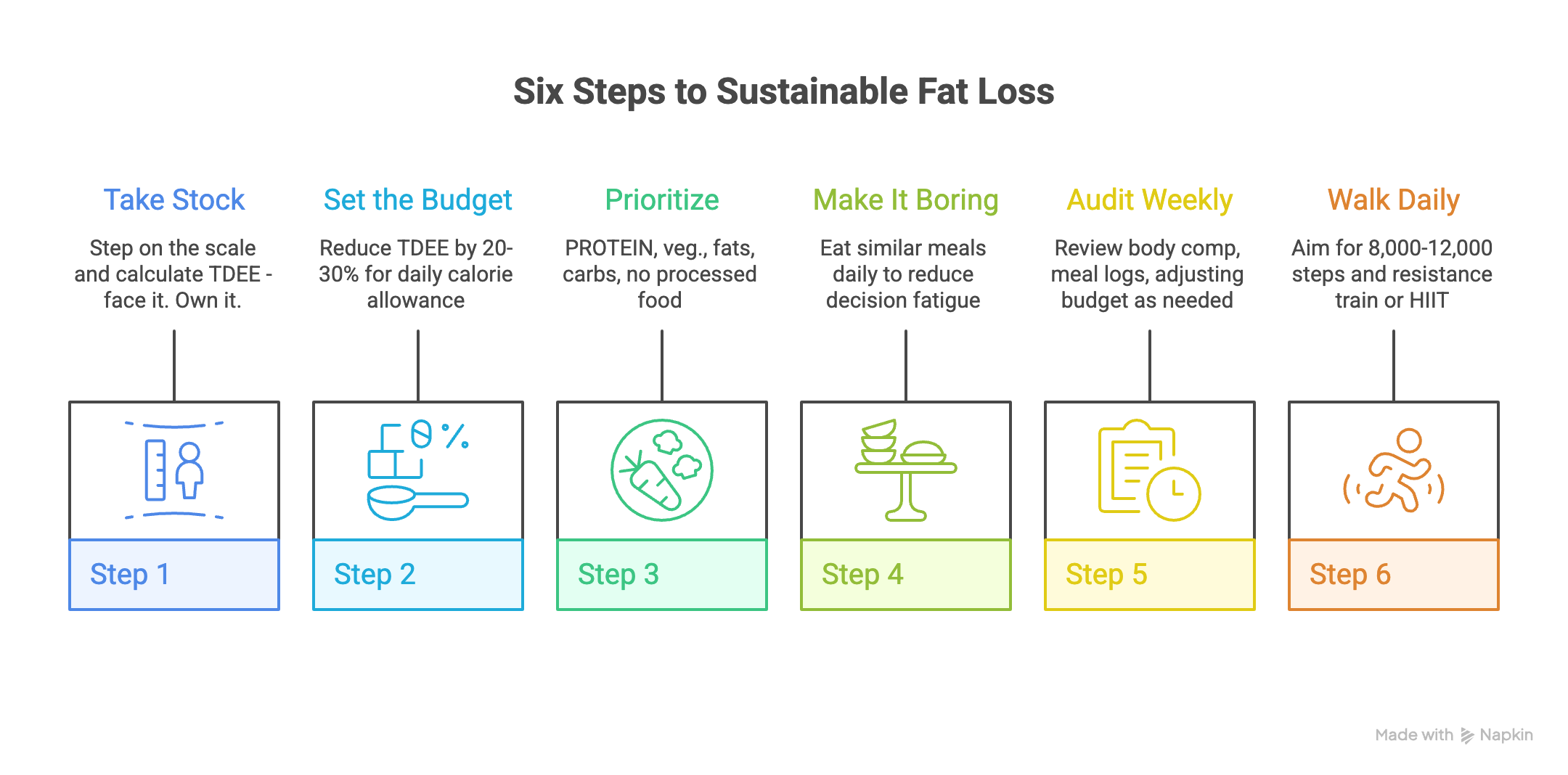
six 6 steps to sustainable fat loss

Final Thoughts

Fat loss is a budget problem. The science confirms this. The mechanism is energy deficit. The strategy is prioritization. The tool is consistent tracking.

Most people fail because they spend their calories like they are rich when their body is already in debt. They buy the luxury items first. They skip the audit. They restart every Monday with a new diet instead of fixing the budget they already have.

I lost 25 kilograms at 52 by treating my calories like money. Protein was rent. Vegetables were utilities. Everything else was discretionary. I tracked every day. I audited every week. I did not need a fancy plan. I needed a budget.

Scientific References

1. Strasser, B., Spreitzer, A., & Haber, P. (2007). Fat loss depends on energy deficit only, independently of the method for weight loss. Annals of Nutrition and Metabolism, 51(5), 428–432. https://pubmed.ncbi.nlm.nih.gov/18025815/

2. Leidy, H.J., Clifton, P.M., Astrup, A. et al. (2015). The role of protein in weight loss and maintenance. American Journal of Clinical Nutrition, 101(6), 1320S–1329S. https://pubmed.ncbi.nlm.nih.gov/25926512/

3. Longland, T.M., Oikawa, S.Y., Mitchell, C.J. et al. (2016). Higher compared with lower dietary protein during an energy deficit combined with intense exercise promotes greater lean mass gain and fat mass loss: a randomized trial. American Journal of Clinical Nutrition, 103(3), 738–746. https://pubmed.ncbi.nlm.nih.gov/26817506/

4. Burke, L.E., Wang, J., & Sevick, M.A. (2011). Self monitoring in weight loss: a systematic review of the literature. Journal of the American Dietetic Association, 111(1), 92–102. https://pubmed.ncbi.nlm.nih.gov/21185970/

5. Emmerich, S.D., Fryar, C.D., Stierman, B., & Ogden, C.L. (2024). Prevalence of Obesity Among Adults: United States, August 2021–August 2023. NCHS Data Brief No. 508. https://www.cdc.gov/nchs/products/databriefs/db508.htm

fat lossweight lossabsexecutivesleaderstransformationdebt
Back to Blog

Budget Your Calories

March 09, 20267 min read

Budget Your Calories: Why Fat Loss Works Exactly Like Paying Off Debt

If you are behind on payments, you do not keep spending like nothing happened. You tighten your budget. You cut luxuries. You prioritize necessities until the books balance.

Fat loss operates on the same principle. Your body runs a ledger. Calories in versus calories out. When you spend more than you earn, the surplus gets stored as fat. When you consistently spend less than you earn, the deficit forces your body to pull from its reserves. That reserve is body fat.

This is not an opinion. A randomized controlled trial published in Annals of Nutrition and Metabolism by Strasser et al. (2007) demonstrated that fat loss depends on energy deficit alone, independent of the method used to create it. Whether you diet, exercise, or combine both, the deficit is what drives the result.

Yet 40.3% of American adults are obese, according to the most recent CDC data from the National Health and Nutrition Examination Survey (Emmerich et al., NCHS Data Brief No. 508, 2024). The issue is not that people lack information. The issue is that they never learned to budget.

Your Body Runs on a Balance Sheet

Think of your Total Daily Energy Expenditure (TDEE) as your income. It is the number of calories your body burns every day through resting metabolism, digestion, movement, and exercise. Everything you eat is an expense against that income.

When expenses exceed income, you go into calorie debt. But unlike financial debt, calorie surplus does not show up as a bill. It shows up around your midsection. When income exceeds expenses, you operate at a calorie surplus and store the excess as fat.

To lose fat, you need to flip the equation: spend more than you consume. A deficit of 500 calories per day is a well-established target. Research published by Carels et al. (2008) found that individuals who maintained an average energy deficit exceeding 500 calories per day lost nearly four times more weight than those whose deficit fell below that threshold. Consistency of the deficit mattered more than how it was created.

The first step is the same as facing a bank statement when you are in debt. Step on the scale. Get your number. Calculate your TDEE. Set your target. Build a calorie budget with a 20% to 30% reduction below maintenance. That is your operating framework.

Prioritize Your Calorie Spending

When money is tight, you pay rent before you buy concert tickets. The same hierarchy applies to your calories.

Protein is your rent. It is the non-negotiable expense. A comprehensive review by Leidy et al. (2015) in the American Journal of Clinical Nutrition found that protein intakes between 1.2 and 1.6 grams per kilogram of body weight per day improved appetite control, increased satiety, and supported fat loss while preserving lean mass. A separate trial by Longland et al. (2016) showed that participants consuming 2.4 grams per kilogram per day during a 40% calorie deficit gained lean mass while losing 4.8 kg of fat in just four weeks. Protein keeps you full. It preserves muscle. It reduces cravings. It is the single most important line item in your calorie budget.

Vegetables are your utilities. High in volume, high in nutrients, low in calories. They fill your stomach without draining your budget. Two to three servings per meal creates physical fullness that reduces the temptation to overspend on calorie dense foods.

Healthy fats and complex carbs are your transport costs. Necessary for energy and hormone function, but you control the amount. When the deficit needs to tighten, these are where you make cuts first, not protein, not vegetables.

Processed food is the luxury purchase. Until your protein target is hit, your vegetables are in, and you are operating within your calorie budget, the luxuries wait. This is not deprivation. This is prioritization. You would not buy designer shoes while your electricity is being disconnected. Apply the same logic to your plate.

Track Like Your Bank Account Depends on It

Nobody gets out of financial debt without looking at their statements. Fat loss is no different.

A systematic review in the Journal of the American Dietetic Association by Burke et al. (2011) found a consistent and significant association between self-monitoring of dietary intake and weight loss across 22 studies, including randomized controlled trials. A more recent meta-analysis by Lemacks et al. (2019) confirmed that digital self-monitoring of both diet and physical activity produced statistically significant weight loss (mean difference of 2.87 kg), with tailored interventions being significantly more effective than non-tailored ones.

Tracking works for the same reason budgeting apps work. Awareness changes behavior. When you log every meal, you see exactly where your calories are going. You spot the leaks. You identify the luxury spending you did not realize you were doing. You make corrections before a bad day becomes a bad week.

The protocol is straightforward. Weigh yourself daily. Log every meal. Measure waist circumference weekly. Review trends every seven days. This is your financial audit. People who track consistently make better decisions because they operate on data, not guesswork.

The Budget System That Works

Step 1: Face the number. Step on the scale. Calculate your TDEE using your current weight, height, age, and activity level. This is your calorie income.

Step 2: Set the budget. Reduce your TDEE by 20% to 30%. This is your daily calorie allowance. Aggressive enough to produce results. Moderate enough to sustain for months.

Step 3: Prioritize spending. Protein first (1.8 to 2.2g per kg body weight). Vegetables second. Fats and carbs third. Processed food last, and only when the budget allows.

Step 4: Make it boring. Eat similar meals daily. Predictable food removes decision fatigue. Boring food stops emotional spending. The same five meals on rotation will outperform a different recipe every night.

Step 5: Audit weekly. Review your weight trend, your waist measurement, and your meal logs. Adjust the budget if progress stalls. The system works because it treats fat loss like the accounting problem it is.

Step 6: Walk daily. Aim for 8,000 to 12,000 steps. Walking is the equivalent of earning a side income. It increases your calorie expenditure without the excessive hunger that intense exercise often triggers. Combine with resistance training three to four times per week to preserve the lean mass that protein protects.

six 6 steps to sustainable fat loss

Final Thoughts

Fat loss is a budget problem. The science confirms this. The mechanism is energy deficit. The strategy is prioritization. The tool is consistent tracking.

Most people fail because they spend their calories like they are rich when their body is already in debt. They buy the luxury items first. They skip the audit. They restart every Monday with a new diet instead of fixing the budget they already have.

I lost 25 kilograms at 52 by treating my calories like money. Protein was rent. Vegetables were utilities. Everything else was discretionary. I tracked every day. I audited every week. I did not need a fancy plan. I needed a budget.

Scientific References

1. Strasser, B., Spreitzer, A., & Haber, P. (2007). Fat loss depends on energy deficit only, independently of the method for weight loss. Annals of Nutrition and Metabolism, 51(5), 428–432. https://pubmed.ncbi.nlm.nih.gov/18025815/

2. Leidy, H.J., Clifton, P.M., Astrup, A. et al. (2015). The role of protein in weight loss and maintenance. American Journal of Clinical Nutrition, 101(6), 1320S–1329S. https://pubmed.ncbi.nlm.nih.gov/25926512/

3. Longland, T.M., Oikawa, S.Y., Mitchell, C.J. et al. (2016). Higher compared with lower dietary protein during an energy deficit combined with intense exercise promotes greater lean mass gain and fat mass loss: a randomized trial. American Journal of Clinical Nutrition, 103(3), 738–746. https://pubmed.ncbi.nlm.nih.gov/26817506/

4. Burke, L.E., Wang, J., & Sevick, M.A. (2011). Self monitoring in weight loss: a systematic review of the literature. Journal of the American Dietetic Association, 111(1), 92–102. https://pubmed.ncbi.nlm.nih.gov/21185970/

5. Emmerich, S.D., Fryar, C.D., Stierman, B., & Ogden, C.L. (2024). Prevalence of Obesity Among Adults: United States, August 2021–August 2023. NCHS Data Brief No. 508. https://www.cdc.gov/nchs/products/databriefs/db508.htm

fat lossweight lossabsexecutivesleaderstransformationdebt
Back to Blog

THE HEALTH MANIFESTO

We’re living through the silent collapse

People are tired. Inflamed. Anxious. Overweight. Under-muscled.

Overfed with misinformation, yet undernourished in truth.

This isn’t a book. It’s a call to reclaim what was stolen - energy, strength and clarity.

The ability to say no to a system designed to keep us sick and compliant.

We are sick. Not metaphorically – literally.

Obesity is skyrocketing.

Chronic disease is the default.

Anxiety, depression, infertility and autoimmune dysfunction.

The modern epidemic is not one disease, but a whole ecosystem of slow, preventable collapse.

And it’s not your fault.

You’ve been lied to.

Download The Health manifesto for Free

Budget Your Calories

March 09, 20267 min read

Budget Your Calories: Why Fat Loss Works Exactly Like Paying Off Debt

If you are behind on payments, you do not keep spending like nothing happened. You tighten your budget. You cut luxuries. You prioritize necessities until the books balance.

Fat loss operates on the same principle. Your body runs a ledger. Calories in versus calories out. When you spend more than you earn, the surplus gets stored as fat. When you consistently spend less than you earn, the deficit forces your body to pull from its reserves. That reserve is body fat.

This is not an opinion. A randomized controlled trial published in Annals of Nutrition and Metabolism by Strasser et al. (2007) demonstrated that fat loss depends on energy deficit alone, independent of the method used to create it. Whether you diet, exercise, or combine both, the deficit is what drives the result.

Yet 40.3% of American adults are obese, according to the most recent CDC data from the National Health and Nutrition Examination Survey (Emmerich et al., NCHS Data Brief No. 508, 2024). The issue is not that people lack information. The issue is that they never learned to budget.

Your Body Runs on a Balance Sheet

Think of your Total Daily Energy Expenditure (TDEE) as your income. It is the number of calories your body burns every day through resting metabolism, digestion, movement, and exercise. Everything you eat is an expense against that income.

When expenses exceed income, you go into calorie debt. But unlike financial debt, calorie surplus does not show up as a bill. It shows up around your midsection. When income exceeds expenses, you operate at a calorie surplus and store the excess as fat.

To lose fat, you need to flip the equation: spend more than you consume. A deficit of 500 calories per day is a well-established target. Research published by Carels et al. (2008) found that individuals who maintained an average energy deficit exceeding 500 calories per day lost nearly four times more weight than those whose deficit fell below that threshold. Consistency of the deficit mattered more than how it was created.

The first step is the same as facing a bank statement when you are in debt. Step on the scale. Get your number. Calculate your TDEE. Set your target. Build a calorie budget with a 20% to 30% reduction below maintenance. That is your operating framework.

Prioritize Your Calorie Spending

When money is tight, you pay rent before you buy concert tickets. The same hierarchy applies to your calories.

Protein is your rent. It is the non-negotiable expense. A comprehensive review by Leidy et al. (2015) in the American Journal of Clinical Nutrition found that protein intakes between 1.2 and 1.6 grams per kilogram of body weight per day improved appetite control, increased satiety, and supported fat loss while preserving lean mass. A separate trial by Longland et al. (2016) showed that participants consuming 2.4 grams per kilogram per day during a 40% calorie deficit gained lean mass while losing 4.8 kg of fat in just four weeks. Protein keeps you full. It preserves muscle. It reduces cravings. It is the single most important line item in your calorie budget.

Vegetables are your utilities. High in volume, high in nutrients, low in calories. They fill your stomach without draining your budget. Two to three servings per meal creates physical fullness that reduces the temptation to overspend on calorie dense foods.

Healthy fats and complex carbs are your transport costs. Necessary for energy and hormone function, but you control the amount. When the deficit needs to tighten, these are where you make cuts first, not protein, not vegetables.

Processed food is the luxury purchase. Until your protein target is hit, your vegetables are in, and you are operating within your calorie budget, the luxuries wait. This is not deprivation. This is prioritization. You would not buy designer shoes while your electricity is being disconnected. Apply the same logic to your plate.

Track Like Your Bank Account Depends on It

Nobody gets out of financial debt without looking at their statements. Fat loss is no different.

A systematic review in the Journal of the American Dietetic Association by Burke et al. (2011) found a consistent and significant association between self-monitoring of dietary intake and weight loss across 22 studies, including randomized controlled trials. A more recent meta-analysis by Lemacks et al. (2019) confirmed that digital self-monitoring of both diet and physical activity produced statistically significant weight loss (mean difference of 2.87 kg), with tailored interventions being significantly more effective than non-tailored ones.

Tracking works for the same reason budgeting apps work. Awareness changes behavior. When you log every meal, you see exactly where your calories are going. You spot the leaks. You identify the luxury spending you did not realize you were doing. You make corrections before a bad day becomes a bad week.

The protocol is straightforward. Weigh yourself daily. Log every meal. Measure waist circumference weekly. Review trends every seven days. This is your financial audit. People who track consistently make better decisions because they operate on data, not guesswork.

The Budget System That Works

Step 1: Face the number. Step on the scale. Calculate your TDEE using your current weight, height, age, and activity level. This is your calorie income.

Step 2: Set the budget. Reduce your TDEE by 20% to 30%. This is your daily calorie allowance. Aggressive enough to produce results. Moderate enough to sustain for months.

Step 3: Prioritize spending. Protein first (1.8 to 2.2g per kg body weight). Vegetables second. Fats and carbs third. Processed food last, and only when the budget allows.

Step 4: Make it boring. Eat similar meals daily. Predictable food removes decision fatigue. Boring food stops emotional spending. The same five meals on rotation will outperform a different recipe every night.

Step 5: Audit weekly. Review your weight trend, your waist measurement, and your meal logs. Adjust the budget if progress stalls. The system works because it treats fat loss like the accounting problem it is.

Step 6: Walk daily. Aim for 8,000 to 12,000 steps. Walking is the equivalent of earning a side income. It increases your calorie expenditure without the excessive hunger that intense exercise often triggers. Combine with resistance training three to four times per week to preserve the lean mass that protein protects.

six 6 steps to sustainable fat loss

Final Thoughts

Fat loss is a budget problem. The science confirms this. The mechanism is energy deficit. The strategy is prioritization. The tool is consistent tracking.

Most people fail because they spend their calories like they are rich when their body is already in debt. They buy the luxury items first. They skip the audit. They restart every Monday with a new diet instead of fixing the budget they already have.

I lost 25 kilograms at 52 by treating my calories like money. Protein was rent. Vegetables were utilities. Everything else was discretionary. I tracked every day. I audited every week. I did not need a fancy plan. I needed a budget.

Scientific References

1. Strasser, B., Spreitzer, A., & Haber, P. (2007). Fat loss depends on energy deficit only, independently of the method for weight loss. Annals of Nutrition and Metabolism, 51(5), 428–432. https://pubmed.ncbi.nlm.nih.gov/18025815/

2. Leidy, H.J., Clifton, P.M., Astrup, A. et al. (2015). The role of protein in weight loss and maintenance. American Journal of Clinical Nutrition, 101(6), 1320S–1329S. https://pubmed.ncbi.nlm.nih.gov/25926512/

3. Longland, T.M., Oikawa, S.Y., Mitchell, C.J. et al. (2016). Higher compared with lower dietary protein during an energy deficit combined with intense exercise promotes greater lean mass gain and fat mass loss: a randomized trial. American Journal of Clinical Nutrition, 103(3), 738–746. https://pubmed.ncbi.nlm.nih.gov/26817506/

4. Burke, L.E., Wang, J., & Sevick, M.A. (2011). Self monitoring in weight loss: a systematic review of the literature. Journal of the American Dietetic Association, 111(1), 92–102. https://pubmed.ncbi.nlm.nih.gov/21185970/

5. Emmerich, S.D., Fryar, C.D., Stierman, B., & Ogden, C.L. (2024). Prevalence of Obesity Among Adults: United States, August 2021–August 2023. NCHS Data Brief No. 508. https://www.cdc.gov/nchs/products/databriefs/db508.htm

Back to Blog

Disclaimer: This is provided for educational and informational purposes only and does not constitute providing medical advice or professional services. The information provided should not be used for diagnosing or treating a health problem or disease, and those seeking personal medical advice should consult with a licensed physician.

When you’re ready, here are two ways I can help

1. The ShredTech Protocol: Lose fat, build strength, and restore energy with a system built for busy leaders. Evidence-based nutrition, efficient training, real results. Start your transformation here .

2. Private Coaching: For founders and executives who want a complete physical and mental reset. Fully tailored, data-driven, and discreet. Apply here .

Sign up for the weekly mailing list and get exclusive insights, unreleased content, and unfiltered truths the mainstream won’t touch.

Unsubscribe anytime.

Zero guilt. Total control.

ShredTech on Instagram
ShredTech on Facebook
ShredTech on ikTok
Nuno on LinkedIn
ShredTech n YouTube
ShredTech on X
Talk to Us
Soon...
ShredTech on Instagram
ShredTech on Facebook
ShredTech on ikTok
Nuno on LinkedIn
Soon...
Talk to Us
ShredTech on X
ShredTech n YouTube

All the information on this site is provided for educational and informational purposes only and does not constitute providing medical advice or professional services. The information provided should not be used for diagnosing or treating a health problem or disease, and those seeking personal medical advice should consult with a licensed physician.

© Human Due Diligence. 2026.
All Rights Reserved.